Biohacking has evolved from a niche concept associated with technology and performance optimisation into a broader approach to understanding and improving measurable aspects of health. Today, biohacking can encompass nutrition, sleep, physical performance, recovery, metabolic health, stress regulation and data-driven health assessment.
For individuals searching for a biohacking clinic in Delhi, the important question is not simply how many technologies or therapies a centre offers. It is how those tools are selected, interpreted and integrated into an individual’s health strategy.
A personalised biohacking approach can combine health data, functional nutrition, recovery science, sleep optimisation and lifestyle interventions to create a more structured picture of individual health and performance.
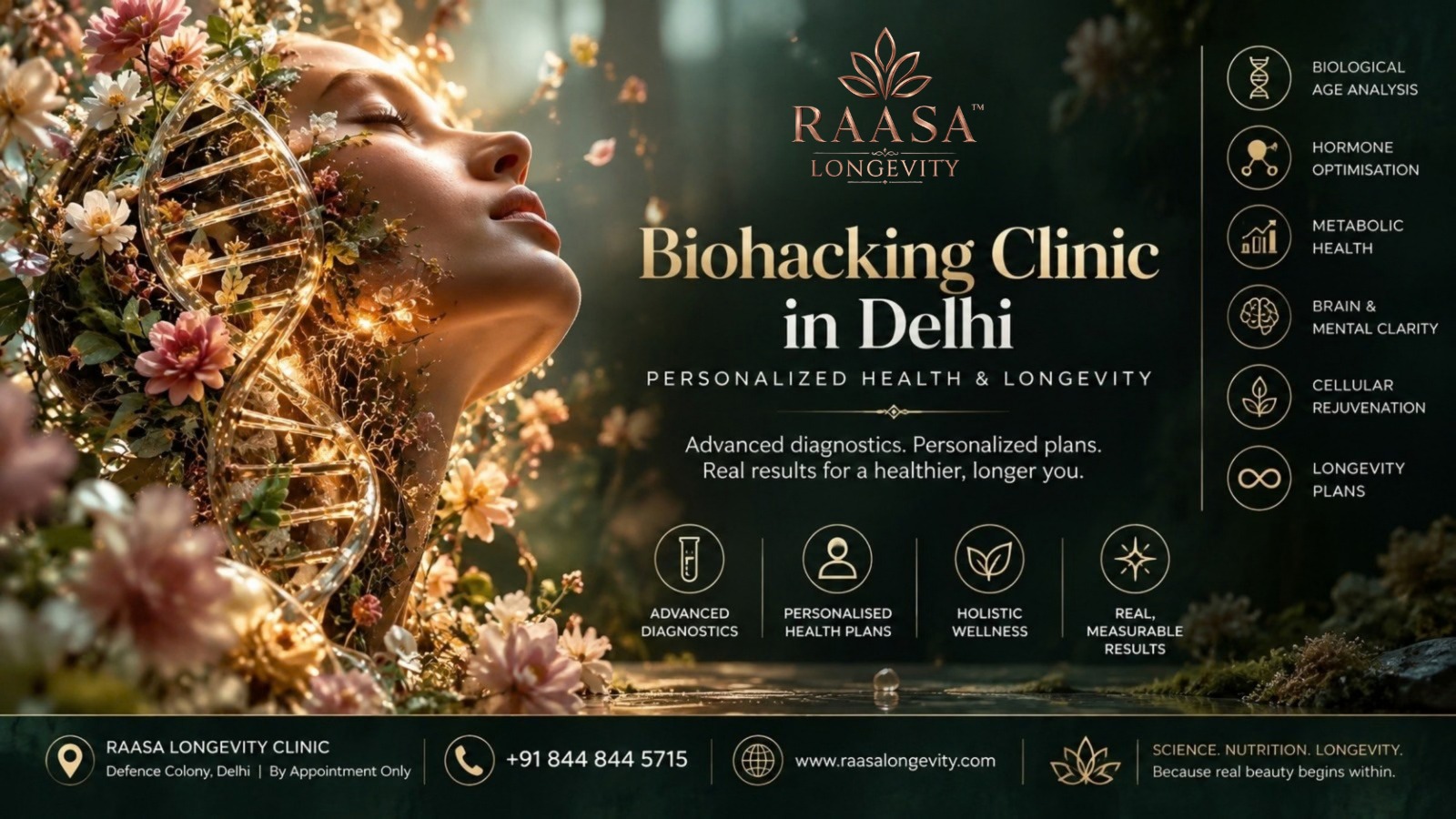
RAASA Longevity positions itself as a medical-grade biohacking and precision longevity suite that combines clinical science with a premium wellness environment and data-driven protocols.
Biohacking broadly refers to the use of lifestyle strategies, technology, measurements, and behavioural interventions to understand and potentially optimise aspects of human biology.
Depending on the approach, biohacking can involve:
The term is broad, and not every biohacking intervention has the same level of scientific evidence. A responsible programme should distinguish between established health practices, emerging technologies and interventions that require further research.
A biohacking clinic or centre typically combines health assessment with selected technologies and lifestyle interventions intended to support health optimisation.
Unlike a conventional wellness programme that may focus primarily on relaxation or lifestyle advice, a more data-led biohacking model can begin with measurable health information.
The process may involve:
Assess → Analyse → Personalise → Implement → Monitor → Optimise
This approach can make the programme more individualised rather than relying on generic protocols.
A biohacking intervention that works well for one person may not be appropriate for another.
Individual differences can include:
This is why simply purchasing or trying multiple wellness technologies does not necessarily constitute a meaningful biohacking strategy.
Personalisation requires understanding the individual’s baseline and selecting interventions according to relevant goals and professional assessment.
Modern longevity programmes increasingly use health measurements to understand areas associated with healthy ageing.
Depending on the programme, assessments may examine:
RAASA states that its longevity framework incorporates advanced diagnostics and biological-age-related assessment as part of its personalised approach.
The value of testing depends on the quality of the measurement, its interpretation, and whether it leads to an appropriate action plan.
Metabolic health is an important area of longevity-focused biohacking.
Relevant factors may include:
Rather than focusing on a single measurement, a comprehensive approach considers these factors together.
Nutrition remains one of the most accessible forms of health optimisation.
A functional nutrition strategy can take into account an individual’s dietary habits, nutritional requirements, metabolic profile, digestive health, physical activity, and long-term objectives.
Potential areas of focus include:
RAASA describes its approach as precision functional nutrition with a focus on metabolic health, hormonal balance, and gut health.
Sleep is one of the most important foundations of recovery.
Biohacking approaches to sleep may involve:
RAASA’s current longevity framework includes its Bio-Sync Engine, which it describes as integrating sleep engineering with AI-powered smart-bed technology and physiological alignment.
Technology can support sleep optimisation, but it should complement fundamental sleep behaviours rather than replace them.
High performance requires adequate recovery.
Recovery-focused biohacking can involve a combination of:
RAASA describes recovery-centric fitness and advanced recovery as components of its longevity framework.
The relationship between stress, sleep, recovery and overall wellbeing has become an important area of modern wellness.
Some biohacking programmes incorporate techniques designed to support relaxation and nervous-system regulation, including breathing practices, mindfulness, guided relaxation and other interventions.
RAASA’s stated framework includes vagus-nerve optimisation and nervous-system regulation as part of its broader personalised wellness approach.
Longevity is closely connected with maintaining physical capability.
A performance-oriented biohacking programme may assess or support:
The objective should not simply be higher performance numbers. Maintaining physical function is also relevant to healthy ageing and long-term independence.
| Area | Traditional Wellness | Personalised Biohacking |
| Primary focus | General wellbeing | Individual health optimisation |
| Assessment | May be limited | Often more data-led |
| Nutrition | General dietary guidance | Personalised functional nutrition |
| Sleep | General sleep advice | May include tracking and sleep technology |
| Recovery | Relaxation-focused | Can include performance and physiological recovery |
| Metabolic health | May receive limited attention | Can be a central component |
| Technology | Usually limited | May incorporate specialised technologies |
| Biological age | Rarely addressed | May be assessed |
| Personalisation | Varies | Usually a core principle |
| Monitoring | Often limited | Can include ongoing data tracking |
The distinction is not absolute. Some conventional wellness programmes also incorporate advanced diagnostics and technology.
The technologies available at biohacking centres vary considerably.
Depending on the programme, technologies may include:
RAASA’s published programme information lists modalities including PEMF, red-light therapy, far-infrared therapies and advanced sleep technology.
The presence of a technology alone should not be considered evidence of its effectiveness for every health objective. Its relevance depends on the specific intervention, evidence base, individual circumstances, and appropriate professional guidance.
RAASA Longevity positions its model at the intersection of medical-grade biohacking, precision longevity and luxury wellness.
Its published framework includes:
The stated objective is to move beyond isolated wellness treatments and create a more integrated health optimisation framework for individuals seeking personalised longevity and performance strategies.
RAASA is based in Defence Colony, New Delhi, and identifies Dr. Poonam Duneja as its founder. Its official profile describes her background in clinical dietetics, diabetes education, and functional nutrition.
Biohacking may be relevant to individuals interested in understanding and optimising specific aspects of their health or performance.
Potential groups include:
However, biohacking is not automatically appropriate for everyone. Existing medical conditions, medications, pregnancy, age, and other factors may affect whether a particular intervention is suitable.
Professionals with demanding schedules often face a combination of:
For these individuals, a personalised programme can focus on practical areas such as sleep consistency, nutritional quality, movement, recovery and stress management.
RAASA specifically describes its longevity programmes as being designed for high performers, entrepreneurs, leaders and professionals managing demanding personal and professional responsibilities.
Sleep optimisation is one of the more accessible areas of biohacking.
Before adding advanced technology, foundational sleep practices remain important:
Technology can then be considered as an additional tool where appropriate.
Nutrition can influence energy, metabolic health, body composition and physical performance.
A personalised biohacking programme may therefore combine health data with nutritional planning.
Rather than recommending a universal “biohacking diet”, the approach can consider:
Health profile: Relevant biomarkers and health information.
Lifestyle: Work patterns, travel and activity levels.
Nutrition: Dietary quality and nutritional adequacy.
Performance: Training and physical objectives.
Recovery: Sleep and workload.
Goals: Healthspan, performance or lifestyle priorities.
This makes functional nutrition an important foundation for a personalised longevity strategy.
If you are researching a biohacking clinic in Delhi, consider the following factors.
Understand who evaluates your health information and who is responsible for recommendations.
Ask what is being measured, why it is being measured, and how the results will influence your programme.
A meaningful programme should adapt to your individual health profile rather than offering the same protocol to everyone.
Ask about the evidence supporting individual technologies and distinguish established interventions from emerging approaches.
Consider whether nutrition, sleep, physical activity, recovery, and metabolic health are connected within the programme.
Find out whether the clinic tracks progress and adjusts recommendations over time.
A biohacking centre should recognise when an issue requires conventional medical assessment or specialist care.
When technology is guided by individual biology. The objective is not to collect more data or use more devices, but to understand what the body needs and create a personalised strategy around nutrition, recovery, sleep and long-term health.”
Poonam Duneja, Founder, RAASA Longevity
The broader principle is that health optimisation should remain centred on the individual rather than the technology itself.
For individuals searching for a biohacking clinic in Delhi, the most important consideration is the quality of the overall framework rather than the number of devices or treatments available.
A meaningful biohacking programme should connect assessment with action. It should help an individual understand their health profile, identify relevant priorities, and implement appropriate changes across nutrition, sleep, recovery, metabolic health, and physical performance.
RAASA Longevity’s current positioning combines medical-grade biohacking with precision longevity, personalised metabolic mapping, functional nutrition, sleep technology, recovery, and advanced diagnostics.
For people interested in a more personalised approach to health and longevity, this model represents an emerging direction in premium wellness: using data and technology alongside foundational lifestyle practices rather than treating technology as an end in itself.
A biohacking clinic in Delhi is a wellness or health optimisation centre that may combine diagnostics, technology, nutrition, recovery strategies, sleep optimisation and lifestyle interventions to support personalised health goals.
Biohacking broadly refers to using lifestyle strategies, technology, measurements and behavioural interventions to understand or optimise aspects of human biology.
Biohacking is a broad term covering interventions with very different levels of scientific evidence. Some practices, such as regular exercise, adequate sleep and balanced nutrition, have strong evidence for health benefits, while evidence for some newer technologies remains emerging.
Depending on the provider, a programme may include health assessments, biomarker analysis, functional nutrition, sleep optimisation, recovery strategies, physical-performance assessment and selected wellness technologies.
Personalised biohacking involves selecting health strategies and technologies according to an individual’s health profile, lifestyle, goals and relevant measurements rather than following a generic protocol.
Some biohacking strategies overlap with established healthy-ageing practices such as exercise, nutrition, sleep and metabolic health management. Other longevity technologies are still being researched, so claims should be evaluated according to the evidence supporting each intervention.
Biological age testing uses selected biomarkers or physiological measurements to estimate aspects of biological ageing. Different tests use different methodologies and should be interpreted accordingly.
Some lifestyle interventions may improve health markers associated with ageing, but the interpretation of biological-age changes depends on the test used and the underlying measurements. No single biohacking intervention guarantees a reduction in biological age.
Nutrition is a major component of health optimisation. Personalised nutrition can address dietary quality, nutrient adequacy, metabolic health, gut health, physical performance and individual goals.
Sleep optimisation can involve behavioural changes, environmental adjustments, tracking and, in some programmes, technology. Persistent sleep problems should be assessed by an appropriately qualified healthcare professional.
Metabolic biohacking generally refers to strategies intended to understand or support metabolic health through nutrition, exercise, sleep, glucose monitoring, body composition and other relevant measures.
Technologies vary between providers and may include wearable tracking, sleep technology, continuous glucose monitoring, photobiomodulation, PEMF, infrared technologies and performance-monitoring systems.
Not necessarily. Individual health conditions, medications, age, and other circumstances can affect whether particular interventions are appropriate. Professional assessment is important before using advanced interventions.
No. Biohacking and wellness interventions should not replace diagnosis or treatment from appropriately qualified healthcare professionals.
A personalised programme may be relevant to professionals managing demanding schedules, travel, high cognitive workloads and limited recovery time, particularly when the focus is on practical health optimisation.
Sleep biohacking refers to strategies intended to improve sleep quality or consistency through behavioural practices, environmental changes, tracking and selected technologies.
Recovery biohacking involves strategies designed to support recovery from physical and mental demands. It may include sleep, nutrition, exercise programming, relaxation, mobility, and selected recovery technologies.
RAASA describes its model as combining medical-grade biohacking, precision longevity, advanced diagnostics, metabolic mapping, functional nutrition, sleep optimisation, and recovery within a personalised wellness framework.
RAASA Longevity identifies its Delhi location as Defence Colony, New Delhi. Its official website lists the address as E-13, First Floor, Above Fortis Cancer Institute, Defence Colony, New Delhi 110024.
The process can begin with an initial consultation or health assessment to understand your goals, lifestyle and relevant health information. Appropriate diagnostics and interventions can then be considered according to individual requirements.
Disclaimer: The information in this article is provided solely for educational, informational, and analytical purposes and is based on publicly available media interviews and reports. Metabolic needs, health conditions, and nutritional requirements vary significantly from person to person. Always consult a certified physician, registered dietitian, or qualified healthcare professional before making substantial changes to your diet, fasting habits, or exercise routine.