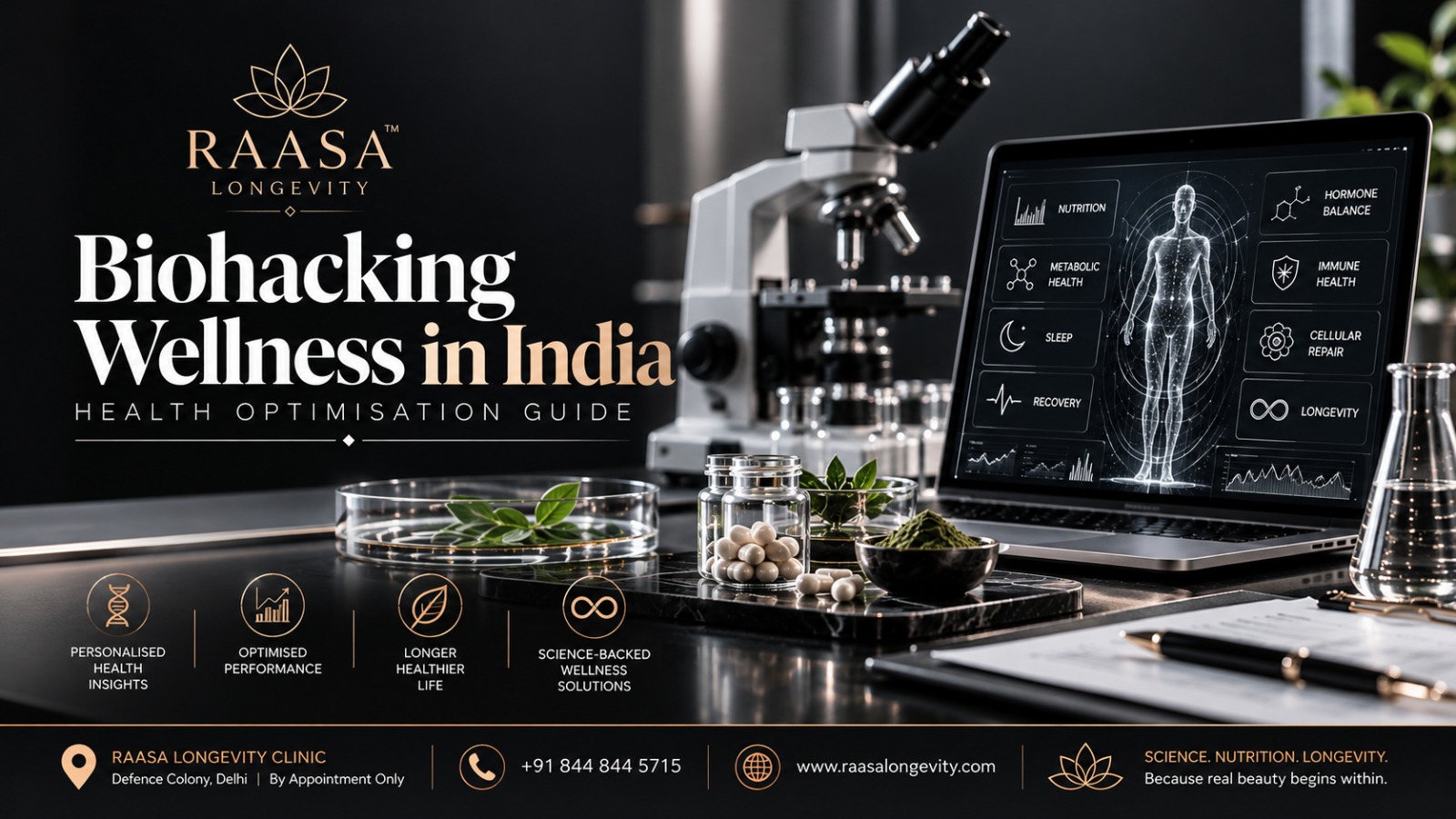

Biohacking wellness is an approach to understanding how everyday behaviours, nutrition, recovery strategies, technology, and measurable health data may influence how the body functions.
Rather than following a generic wellness routine, biohacking focuses on personalisation, measurement and informed experimentation. The objective is not simply to do more, but to understand what may be relevant to an individual’s health, performance, recovery and long-term wellbeing.
In India, interest in biohacking wellness is growing as more people look beyond conventional health check-ups and become interested in preventive health, metabolic wellbeing, healthy ageing, physical performance and healthspan.
A personalised biohacking approach may bring together areas such as:
The key principle is simple: your wellness strategy should be based on your individual needs rather than a generic trend.
India has experienced a growing interest in preventive healthcare, fitness, nutrition, wearable technology, and personalised wellness.
People increasingly use smartwatches, fitness trackers, continuous glucose monitors and other digital tools to understand aspects of their daily health. At the same time, there is growing awareness of metabolic health, sleep, stress, nutrition and physical performance.
Several lifestyle factors can make personalised wellness particularly relevant:
Biohacking wellness does not mean using expensive technology for every problem. Instead, it can involve identifying the most relevant areas of improvement and building a structured strategy around them.
Traditional wellness programmes often provide broad recommendations that can be useful for the general population. Biohacking wellness takes the concept further by incorporating individual data and, where appropriate, measurable outcomes.
| Conventional Wellness | Biohacking Wellness |
| General lifestyle advice | Personalised health strategy |
| Standard wellness recommendations | Data-informed recommendations |
| Focus on current wellbeing | Focus on wellbeing, performance and healthspan |
| Generic nutrition advice | Individualised nutritional strategy |
| Exercise recommendations | Movement and performance based on individual needs |
| General stress management | Personalised recovery and stress strategies |
| Periodic health checks | Ongoing measurement where appropriate |
| One-size-fits-most approach | Individualised approach |
Biohacking should complement appropriate medical care rather than replace diagnosis, treatment or clinical supervision.
The most important aspect of biohacking is not technology. It is individualisation.
Two people can have completely different nutritional requirements, sleep patterns, fitness levels, stressors, and recovery needs even if they have the same age and similar lifestyles.
A personalised assessment may consider:
Daily routines, work patterns, travel, physical activity, sleep and stress can provide important context.
Dietary patterns, meal timing, food quality and individual nutritional requirements can influence metabolic and overall health.
Blood glucose regulation, lipid profile, body composition and other relevant markers can provide insight into metabolic wellbeing.
Strength, endurance, mobility and cardiovascular fitness can be considered when building a performance and longevity strategy.
Sleep, rest, training load and stress can influence how effectively the body recovers.
Someone focused on healthy ageing may require a different strategy from someone primarily interested in athletic performance or improving daily energy.
There is no universal biohacking protocol. A responsible programme should be adapted to the individual.
Depending on the person’s goals, a wellness optimisation strategy may include several components.
The starting point is understanding the person’s current lifestyle, health priorities and objectives.
This can include:
Nutrition is one of the most accessible components of health optimisation.
A personalised nutritional strategy may focus on:
Functional nutrition can be particularly useful when the objective is to connect dietary choices with broader aspects of health.
The gut is an important component of overall wellbeing and is increasingly studied in relation to digestion, immunity and metabolic health.
A gut-focused wellness strategy may consider:
However, gut health should not be reduced to a single microbiome test or supplement. A broader assessment of diet and lifestyle is often more meaningful.
Metabolic health is an important part of long-term wellness.
Factors commonly considered include:
Improving metabolic health is generally more meaningful than chasing isolated wellness metrics.
A personalised strategy may combine nutrition, resistance training, cardiovascular activity, sleep optimisation and other lifestyle interventions according to individual circumstances.
Sleep is one of the foundations of health optimisation.
A sophisticated biohacking programme should not treat sleep as simply another metric on a smartwatch. The focus should be on sleep quality, consistency and the factors that may interfere with recovery.
Useful strategies can include:
Wearables can provide useful trends, but their measurements should be interpreted cautiously rather than treated as definitive clinical diagnoses.
Strength, cardiovascular fitness, mobility and physical capacity are closely connected with healthy ageing.
A biohacking wellness strategy may therefore include measurable aspects of physical performance such as:
Metrics such as VO₂ max can provide useful information about cardiovascular fitness, while strength and functional capacity can offer additional insight into physical resilience.
The goal is not necessarily to become an elite athlete. It is to maintain physical capability throughout life.
Modern lifestyles can create significant demands on recovery.
Work pressure, travel, prolonged screen use, insufficient sleep and high training loads can all contribute to inadequate recovery.
A personalised wellness strategy may therefore incorporate:
Technologies marketed for stress or nervous-system optimisation should be assessed according to their evidence, intended use and individual suitability.
Biohacking wellness may involve technology, but technology should serve a purpose rather than become the objective itself.
Depending on the programme, technologies may include:
Fitness trackers and smartwatches can provide information about activity, heart rate and sleep-related trends.
Red-light or photobiomodulation approaches are being studied for applications including tissue recovery and other areas of wellness. Evidence varies by application, device and protocol.
Infrared-based wellness technologies are used in some recovery and relaxation settings. Their specific benefits depend on the technology and intended application.
Compression, mobility and other recovery-focused tools may be incorporated into selected wellness programmes.
The important consideration is whether a technology has a clear rationale for the individual rather than whether it is simply marketed as “advanced”.
Biohacking wellness can support a proactive approach to healthy ageing by focusing on modifiable aspects of health.
These may include:
Healthy ageing is a long-term process. There is no single technology, supplement or protocol that can guarantee a particular ageing outcome.
At RAASA Longevity, biohacking wellness can be approached as part of a broader personalised health and longevity framework.
Rather than beginning with a technology, the emphasis is on understanding the individual.
This may involve integrating areas such as:
Understanding current health, lifestyle, goals and relevant measurable markers.
Developing nutrition strategies around individual requirements rather than generic diet trends.
Identifying lifestyle factors that may influence metabolic wellbeing and supporting sustainable improvements.
Considering strength, cardiovascular fitness, mobility and physical capacity as components of long-term health.
Assessing lifestyle factors that influence recovery and helping build sustainable routines.
Considering appropriate technologies where they have a relevant role within an individual’s broader wellness strategy.
Connecting present-day health behaviours with long-term healthspan and healthy ageing goals.
This approach positions biohacking as a tool for informed health optimisation, rather than a collection of fashionable interventions.
Biohacking wellness may appeal to people who want a more structured approach to understanding and improving their health.
This can include:
However, suitability depends on individual circumstances. Biohacking should not be used as a substitute for medical evaluation when symptoms or medical conditions require clinical attention.
Busy professionals often prioritise productivity while treating sleep, nutrition and recovery as secondary considerations.
A personalised approach can help identify where lifestyle optimisation may have the greatest practical value.
For example, someone travelling frequently may need a different strategy for:
The objective is not to create a complicated schedule. It is to build a system that can realistically be maintained.
The internet is filled with rapidly changing biohacking trends.
These may include extreme fasting protocols, large supplement stacks, aggressive cold exposure routines, unvalidated testing and expensive devices.
A more responsible approach asks:
This helps separate health optimisation from wellness experimentation without context.
When researching biohacking wellness services, consider the following:
The programme should account for individual goals, lifestyle and relevant health information.
Understand who is designing and supervising the programme and what their professional qualifications are.
Find out which assessments are used and why they are relevant.
Ask what a technology is intended to do and what evidence supports its use.
Nutrition, exercise, sleep, recovery and metabolic health should not necessarily be treated as isolated areas.
Be cautious of programmes promising guaranteed biological-age reductions, dramatic transformations or specific health outcomes.
“The purpose of personalised wellness is not to chase every new biohacking trend. It is to understand the individual, identify meaningful areas for improvement, and build sustainable strategies around measurable health and lifestyle goals.”
Dr. Poonam Duneja, Founder, RAASA Longevity
The future of biohacking is likely to become increasingly data-informed and personalised.
Wearable technology, health monitoring, personalised nutrition, advanced diagnostics and digital health tools are contributing to a growing ecosystem of measurable wellness.
At the same time, greater access to information makes scientific evaluation increasingly important.
The next phase of biohacking wellness is therefore unlikely to be simply about owning more devices. It is about using relevant information intelligently.
For Indian consumers, this could mean a greater emphasis on preventive health, metabolic wellbeing, physical resilience, recovery and healthy ageing.
Biohacking wellness in India represents a shift towards a more personalised understanding of health.
Instead of following a generic wellness checklist, individuals can use relevant health information, lifestyle assessment, nutrition, exercise, sleep, recovery and carefully selected technologies to develop a more individualised health optimisation strategy.
The most sustainable approach is not necessarily the most complicated one. It is the one that is evidence-informed, personalised, measurable and practical enough to maintain over time.
For people interested in longevity, the ultimate objective should extend beyond short-term performance or appearance. It should include maintaining physical capacity, metabolic health, cognitive wellbeing and quality of life as the years progress.
Biohacking wellness is a personalised approach to health optimisation that may combine lifestyle assessment, nutrition, exercise, sleep, recovery, health data and selected wellness technologies.
Some components of biohacking wellness, such as regular exercise, adequate sleep, balanced nutrition and preventive health practices, have substantial scientific support. Evidence for specific technologies and newer interventions varies considerably.
Depending on the individual, it may include health assessment, personalised nutrition, metabolic health strategies, physical performance, sleep, recovery, stress management and selected wellness technologies.
Biohacking overlaps with wellness but places greater emphasis on personalisation, measurement, experimentation and optimisation.
Certain lifestyle components associated with biohacking, including exercise, nutrition, sleep and metabolic health management, are relevant to healthy ageing. However, no biohacking programme can guarantee a particular ageing outcome.
Biological age is a broad concept intended to describe aspects of physiological ageing using different biomarkers or physiological measures. Different tests use different methodologies.
Some interventions may influence biomarkers used in biological-age models, but results depend on the measurement method and individual circumstances. A change in a biological-age score should not automatically be interpreted as a reversal of ageing.
It can be useful for people who want to structure nutrition, exercise, sleep and recovery around demanding professional schedules. The strategy should remain practical and sustainable.
Nutrition is a major component because dietary quality, protein, fibre, micronutrients, hydration and meal patterns can influence overall health and metabolic wellbeing.
Gut health can be considered within a broader wellness strategy through dietary quality, fibre intake, food variety, hydration and other relevant lifestyle factors.
No. Wearables can provide useful information, but effective health optimisation can be built around basic lifestyle behaviours without relying on extensive technology.
Depending on the centre and programme, technologies may include wearable tracking, photobiomodulation, infrared-based approaches, compression and other recovery-focused technologies.
No. Biohacking wellness should not replace medical diagnosis, treatment or clinically indicated healthcare.
Personalised health optimisation involves adapting lifestyle, nutrition, exercise, recovery and preventive strategies according to an individual’s goals, health information and circumstances.
Personalised biohacking begins with the individual and the problem being addressed, whereas online trends may promote the same intervention to everyone regardless of individual requirements.
Lifestyle factors such as appropriate exercise, nutrition, sleep and recovery can support physical performance. Additional technologies may have specific applications depending on the individual and the evidence available.
Yes. Interest in personalised wellness, longevity, preventive health and health optimisation has expanded in India, with specialist centres offering different combinations of assessments, nutrition and wellness technologies.
Look for qualified professionals, personalised assessments, transparent explanations of testing and technology, evidence-informed recommendations and realistic expectations.
Personalisation and consistency are more important than simply using the newest technology. The strategy should address meaningful health goals and be sustainable.
Begin by identifying your health and wellness objectives, reviewing your current lifestyle and relevant health information, and then developing a structured plan with appropriately qualified professionals.
Disclaimer: The information in this article is provided solely for educational, informational, and analytical purposes and is based on publicly available media interviews and reports. Metabolic needs, health conditions, and nutritional requirements vary significantly from person to person. Always consult a certified physician, registered dietitian, or qualified healthcare professional before making substantial changes to your diet, fasting habits, or exercise routine.